
Request-to-approval process map
Illustrative demonstration · Synthetic scenario · Not a client engagement
Business process improvement and automation
Business challenge
Unstructured equipment requests leave a fictional organization unsure who must decide, what happens on rejection, and whether urgency overrides controls.
Solution architecture / consulting framework
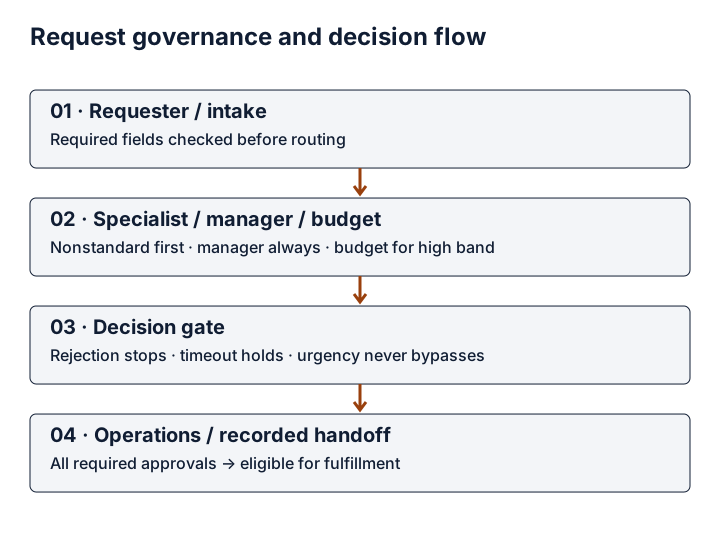
Separate validation, policy routing, reviewer decisions and fulfillment. Every synthetic route uses the same documented rules.
Implementation approach
Discover: map email handoffs. Design: assign decision owners and exception paths. Deliver: test synthetic scenarios. Adopt: provide role-specific guidance and escalation rules.
Technologies and methods
Process mapping, RACI, decision tables and conceptual SharePoint/Power Automate orchestration. The simulation uses local JavaScript, not a cloud workflow or approval service.
Business value — intended, not measured
Consistent routing and traceable decisions. No completed engagement, cycle-time result or automatic security assurance is claimed.
Visual demonstration / consulting deliverable
Improvement brief
Scenario: equipment requests circulate in email with repeated questions and unclear budget ownership. Current flow: requester → shared inbox → manager → budget team → requester for missing details. Future flow: validate first, route by explicit policy, record each decision, and hand off only after required approvals. Intended benefit is accountable decisions, not a measured time saving.
Decision policy
| Rule | Condition | Action |
|---|---|---|
| R1 | Required information missing | Return for clarification; no approval |
| R2 | Request is nonstandard | Specialist review before manager decision |
| R3 | Standard request below 500 synthetic units | Manager review |
| R4 | Standard request at least 500 units | Manager then budget review |
| R5 | Urgent flag | Expedite triage; never bypass a reviewer |
| R6 | Reviewer rejects | Close as rejected; no fulfillment |
| R7 | All required reviewers approve | Eligible for fulfillment; not completed delivery |
| R8 | No response / error | Hold and escalate to process owner; no automatic approval |
RACI and control ownership
| Activity | Responsible | Accountable | Consulted / informed |
|---|---|---|---|
| Complete intake | Requester | Requester | Process owner |
| Policy review | Specialist | Process owner | Manager |
| Business need | Manager | Manager | Requester |
| Budget release | Budget reviewer | Budget owner | Manager |
| Fulfillment | Operations | Operations owner | Requester |
| Exceptions | Process owner | Process owner | All reviewers |
Acceptance and exception cases
| Case | Input | Expected behavior |
|---|---|---|
| A1 | Missing / standard / low | Return for clarification |
| A2 | Complete / nonstandard / high | Specialist → manager → budget |
| A3 | Complete / standard / low | Manager |
| A4 | Complete / standard / high | Manager → budget |
| A5 | Urgent standard low | Expedited triage; manager still required |
| A6 | Any required reviewer rejects | Rejected; fulfillment blocked |
| A7 | All reviewers approve | Eligible for fulfillment only |
| A8 | Timeout at review | Hold; escalate to owner |
Worked examples and measurement plan
SYN-REQ-01: complete standard low-band request routes to manager. Approval makes it eligible for fulfillment, not delivered. SYN-REQ-02: nonstandard high-band request requires specialist, manager and budget approval; a rejection stops the route. Measure clarification rate, review age and exception counts only after a real baseline is collected; none is invented here.
Implementation boundary
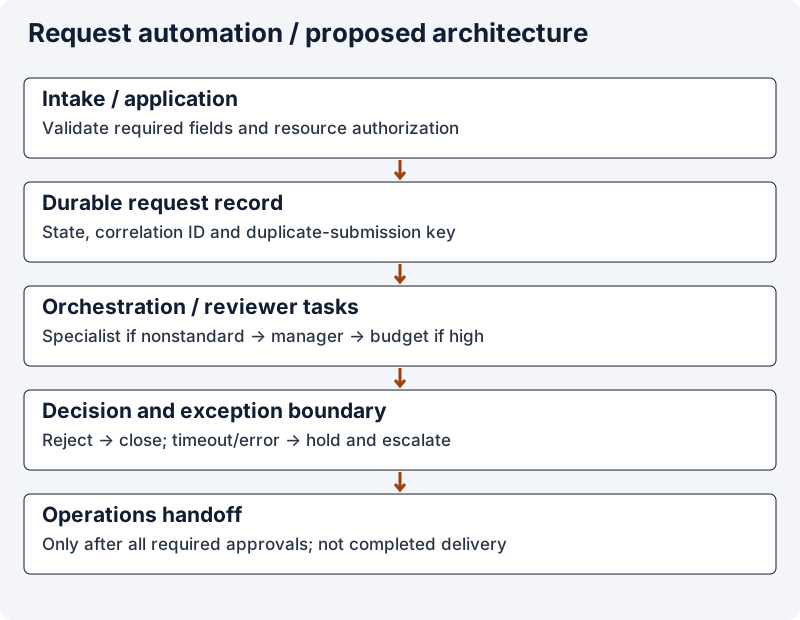
A real implementation would need authorization, durable decision history, duplicate-submission protection, timeout handling and notification failure recovery. A conceptual SharePoint list / Power Automate design is not deployed here. Retrying a notification must not duplicate fulfillment.
Walk through a synthetic request
Choose a scenario, then act as its reviewers. Nothing is submitted or stored. Changing a scenario starts a new simulation only when you choose Start scenario.
Static example: a complete standard request below 500 units requires manager review. Approval permits a fulfillment handoff; rejection closes it. Use the eight cases above without JavaScript.
Download the consulting samples
Open printable process improvement brief (HTML) · Download rulebook (CSV) · Download acceptance cases (CSV)
Consulting design and planning samples
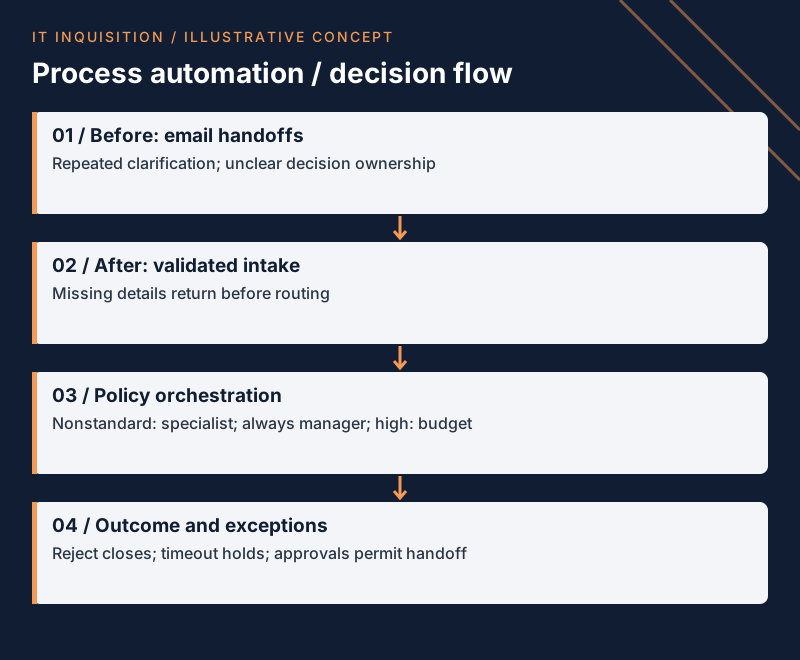
| Stage / boundary | Meaning |
|---|---|
| Before: email handoffs | Repeated clarification; unclear decision ownership |
| After: validated intake | Missing details return before routing |
| Policy orchestration | Nonstandard: specialist; always manager; high: budget |
| Outcome and exceptions | Reject closes; timeout holds; approvals permit handoff |
Integration architecture
Your next mission
Discuss the work ahead.
Define the business challenge, the people affected, and the decisions you need to make.