
Technology decision blueprint
Illustrative solution concept · Synthetic information · Not a client engagement
For an organization that needs reliable integration with explicit security and operational boundaries.
Proposed solution
Make boundaries and tradeoffs visible. This illustrative design makes responsibilities, evidence and exception handling explicit. It is a possibility to adapt through discovery, not a claim of a completed engagement.
Technologies and methods
Enterprise architecture; conceptual Entra ID, Azure integration; ADRs; contract and modernization planning.
Intended business benefits
Clearer decisions, accountable handoffs and usable information. Validate these hypotheses against an agreed baseline; no measured customer results are presented.
Architecture component explorer
All scenario data is synthetic. Selections stay in memory; no accounts, requests or tracking. The initial data remains readable without JavaScript.
Initial synthetic view. Interactive controls appear when JavaScript is available.
| Component | Flow | Trust / security | Decision | Failure handling |
|---|---|---|---|---|
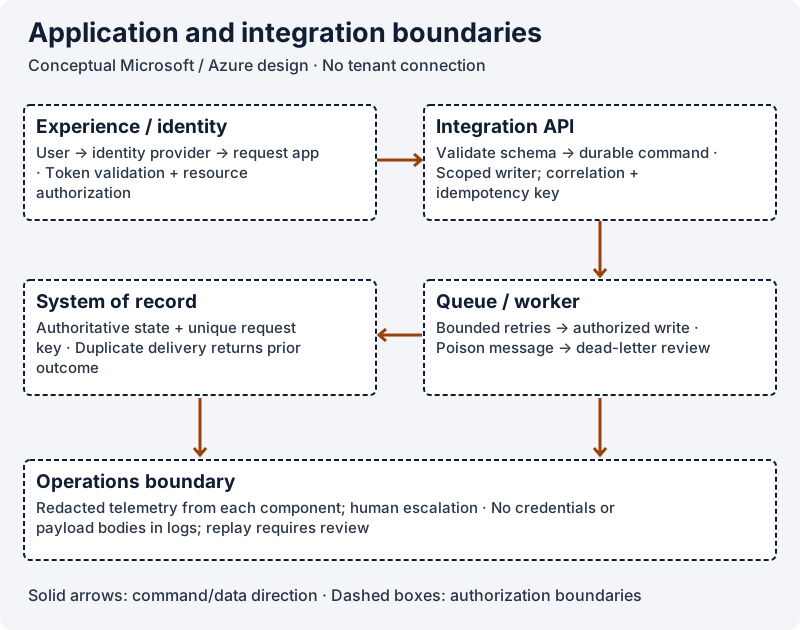
| Identity boundary | Users → identity provider → application token validation | Authenticate centrally; validate issuer, audience and expiry. Enforce authorization per resource. | ADR-01: role-based access; token possession is not sufficient authorization. | Expired or invalid token: reject, record a redacted event, never fall back to anonymous. |
| Request application | User submits validated request → integration API | Server-side schema validation and scoped authorization; never trust browser fields. | ADR-02: keep orchestration outside the user interface. | Invalid input: return validation errors; preserve no visitor input in this demo. |
| Integration API | Authenticated request → versioned command → queue | Least privilege service identity; rate limits and correlation IDs. | ADR-03: return acceptance after durable enqueue, not fulfillment success. | Enqueue failure: explicit retryable error; avoid reporting success. |
| Queue and worker | Command → idempotent worker → system of record; failures → dead-letter review | Queue reader/writer roles separated; bounded retry policy. | ADR-03: asynchronous handoff accepts eventual consistency and operational complexity. | Poison message: bounded retry then dead-letter; operator reviews before replay. |
| System of record | Worker performs authorized write → versioned result event | Private service boundary and restricted write identity; unique idempotency key. | ADR-04: authoritative state stays in the record system, not the queue or report. | Duplicate event: return prior outcome; do not create duplicate business records. |
| Operations and telemetry | Correlation IDs and redacted events from all layers → operational review | Exclude tokens, personal fields and payload bodies from logs; scoped retention. | ADR-05: diagnostics and business reporting have different access and retention. | Alert on dead-letter depth and failure rates; human escalation, no blind replay. |
Design and decision flow
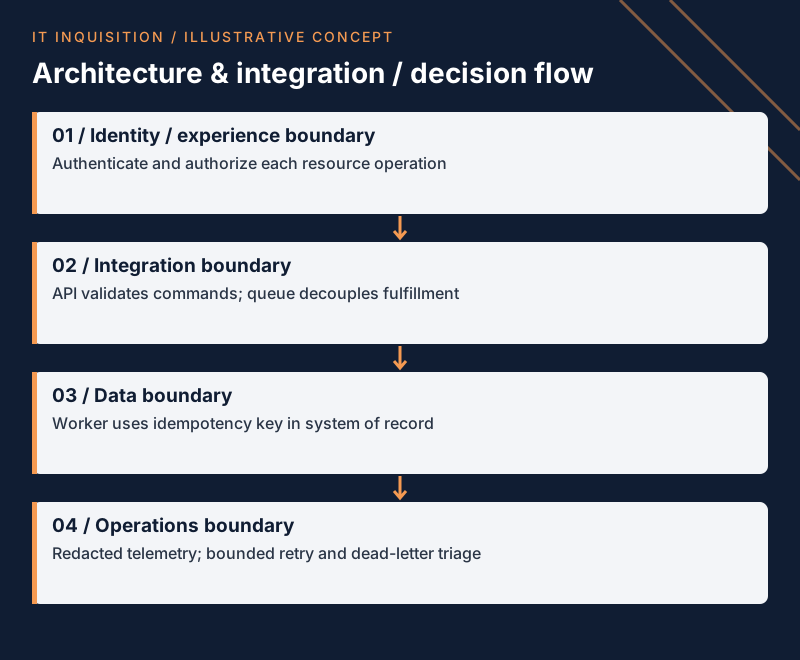
| Stage / boundary | Meaning |
|---|---|
| Identity / experience boundary | Authenticate and authorize each resource operation |
| Integration boundary | API validates commands; queue decouples fulfillment |
| Data boundary | Worker uses idempotency key in system of record |
| Operations boundary | Redacted telemetry; bounded retry and dead-letter triage |
Consulting samples
Integration architecture
Your next mission
Discuss the work ahead.
Define the business challenge, the people affected, and the decisions you need to make.