
Coordinated delivery roadmap
Illustrative solution concept · Synthetic information · Not a client engagement
For an organization that needs visibility into delivery commitments and cross-project dependencies.
Proposed solution
See the work. Surface the decisions.. This illustrative design makes responsibilities, evidence and exception handling explicit. It is a possibility to adapt through discovery, not a claim of a completed engagement.
Technologies and methods
Program governance; milestone gates; dependency analysis; iterative delivery and RAID.
Intended business benefits
Clearer decisions, accountable handoffs and usable information. Validate these hypotheses against an agreed baseline; no measured customer results are presented.
Delivery command view
All scenario data is synthetic. Selections stay in memory; no accounts, requests or tracking. The initial data remains readable without JavaScript.
Initial synthetic view. Interactive controls appear when JavaScript is available.
| Project / ID | Program | Phase / iteration | Status | Milestone / gate | Dependency gate | Backlog items |
|---|---|---|---|---|---|---|
| PRJ-01 · Controlled document release | Operations | Deliver / Iteration 3 | Attention | Pilot release / Reviewer acceptance (not yet accepted) | Predecessors clear; own gate still required | 8 |
| PRJ-02 · Request routing pilot | Operations | Design / Iteration 2 | Blocked | Routing sign-off / Policy approved (not yet accepted) | Waiting for PRJ-01; own gate not yet accepted | 12 |
| PRJ-03 · Role learning rollout | Operations | Adopt / Iteration 3 | On track | Practice workshop / Role tasks verified (not yet accepted) | Waiting for PRJ-01; own gate not yet accepted | 5 |
| PRJ-04 · Interface foundation | Technology | Deliver / Iteration 2 | On track | Contract baseline / Schema tests passed (gate complete) | Gate complete; no further approval for this milestone | 3 |
| PRJ-05 · Reporting model | Technology | Design / Iteration 2 | Attention | Metric definitions / Owner approval (not yet accepted) | Predecessors clear; own gate still required | 9 |
| PRJ-06 · Support transition | Technology | Adopt / Iteration 4 | Blocked | Operational handover / Runbook rehearsed (not yet accepted) | Waiting for PRJ-05; own gate not yet accepted | 6 |
Risk, action, issue and decision register
| ID | Type | Statement | Owner | Priority | Response | State |
|---|---|---|---|---|---|---|
| R-01 | Risk | Reviewer capacity may delay pilot | Delivery lead | High | Reserve reviewer slots before gate | Open |
| A-01 | Action | Validate role-to-task access matrix | Security lead | Medium | Test reader denial in working library | In progress |
| I-01 | Issue | Example schema lacks correlation ID | Integration lead | High | Add contract field before replay test | Open |
| D-01 | Decision | Use versioned asynchronous event contract | Architecture board | Medium | Accepted for synthetic design; revisit latency needs | Recorded |
Dependency readiness is computed from predecessor completion across the full dataset. An On track label is not a release authorization. Program governance resolves cross-project tradeoffs; project governance owns its deliverable and acceptance.
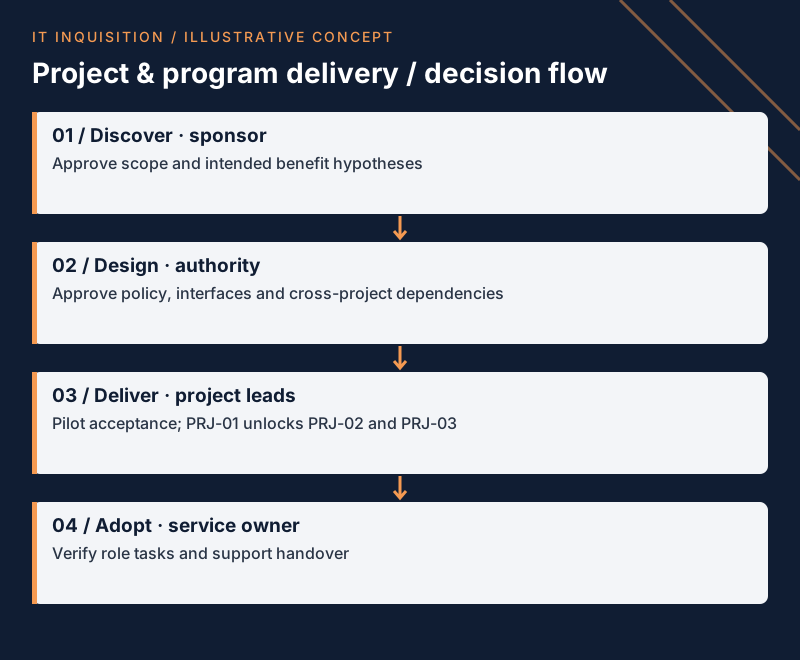
Design and decision flow
| Stage / boundary | Meaning |
|---|---|
| Discover · sponsor | Approve scope and intended benefit hypotheses |
| Design · authority | Approve policy, interfaces and cross-project dependencies |
| Deliver · project leads | Pilot acceptance; PRJ-01 unlocks PRJ-02 and PRJ-03 |
| Adopt · service owner | Verify role tasks and support handover |
Consulting samples
Your next mission
Discuss the work ahead.
Define the business challenge, the people affected, and the decisions you need to make.