
Role-based learning and adoption plan
Illustrative solution concept · Synthetic information · Not a client engagement
For an organization that needs role-based capability and sustained use of new processes.
Proposed solution
Build capability that lasts beyond launch. This illustrative design makes responsibilities, evidence and exception handling explicit. It is a possibility to adapt through discovery, not a claim of a completed engagement.
Technologies and methods
Learning objectives; stakeholder communications; task-based practice; knowledge transfer and adoption measurement.
Intended business benefits
Clearer decisions, accountable handoffs and usable information. Validate these hypotheses against an agreed baseline; no measured customer results are presented.
Role-based curriculum explorer
All scenario data is synthetic. Selections stay in memory; no accounts, requests or tracking. The initial data remains readable without JavaScript.
Initial synthetic view. Interactive controls appear when JavaScript is available.
| Role | Module | Objective | Practice | Evidence |
|---|---|---|---|---|
| Contributor | Prepare a governed document | Apply classification and required metadata | Submit SYN-001 with owner and review date | All required metadata present |
| Reviewer | Make an independent release decision | Return incomplete records without self-approval | Reject missing owner; approve corrected record | Decision reference and segregation recorded |
| Process owner | Manage exceptions and support | Escalate stalled review without bypass | Triage synthetic timeout and route to owner | Escalation owner and next action documented |
| Role | Eligible | Trained | Passed practice | Active in follow-up |
|---|---|---|---|---|
| Contributor | 20 | 16 | 13 | 11 |
| Reviewer | 10 | 9 | 8 | 7 |
| Process owner | 8 | 6 | 5 | 4 |
Scope: Operations Q1 synthetic cohort. Completion = trained / eligible; proficiency = passed / trained; adoption = active / eligible. Active means completing the defined task in the fictional follow-up window. These are illustrative counts, not evidence of a customer outcome.
Design and decision flow
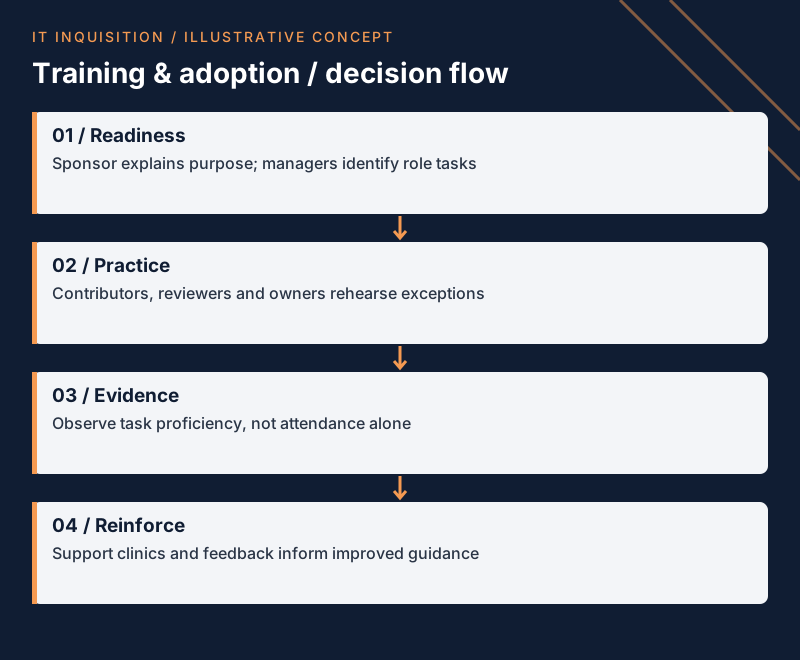
| Stage / boundary | Meaning |
|---|---|
| Readiness | Sponsor explains purpose; managers identify role tasks |
| Practice | Contributors, reviewers and owners rehearse exceptions |
| Evidence | Observe task proficiency, not attendance alone |
| Reinforce | Support clinics and feedback inform improved guidance |
Consulting samples
Your next mission
Discuss the work ahead.
Define the business challenge, the people affected, and the decisions you need to make.